Carbon Footprint Calculator
_______
Free Climate Impact Calculator
Changing something for the better almost always requires measurement first to know what is required to bring forth improvement. For this reason, I recommend that you use the following carbon footprint calculator to estimate your environmental impact based on everyday habits like transportation, travel, and home energy use. When you understand your carbon footprint you are taking the first step toward making more sustainable choices and reducing your impact on the environment.
Measuring Your Annual Emissions
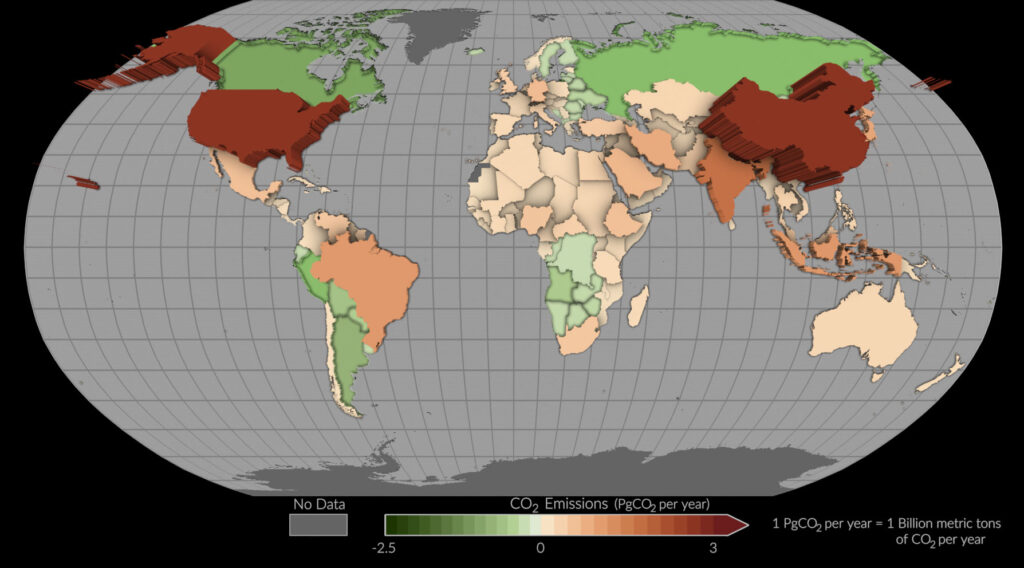
Understanding global carbon emissions helps show how energy use, industry, and population influence climate change across the world. The following map from NASA (National Aeronautics and Space Administration) displays countries that are doing well as well as countries that require changes in policies as they explore how to offset carbon emissions effectively.
First, you can enter your information below to calculate your footprint and learn how small changes can make a big difference. Once you know what your actual carbon footprint is numerically, you can take small and large steps to reduce it like driving less or planting a beautiful tree in your backyard to sequester carbon in the atmosphere and return it back to the earth. Naturally, the miles driven category of the carbon calculator is intended primarily for vehicles that use standard combustion engines. Therefore, if you drive an alternative vehicle, such as a hybrid or electric vehicle (EV), you may be able to greatly reduce or even skip entries in this section, depending on the type of vehicle you drive.
Estimate your Annual Carbon Footprint
Second, you can enter your information below to estimate your annual carbon footprint. When you enter these numbers, you can then begin thinking of ways you can reduce your impact on the environment.
Working Towards a Future of Carbon Neutrality
Third, I recommend setting goals by keeping track of your numbers in a notebook or a digital record can also be kept, for more information on this please explore my article on Carbon Footprint Tracking Apps. To work towards a better environment and to reduce your impact, it is recommended that you release 6.8 kg per day of carbon into the atmosphere which works to be 2,500 kg or 2.5 tons per year.
In Summary
Join me in understanding carbon footprint calculator basics by setting measurable goals to reduce atmospheric carbon emissions to alleviate the effects of climate change. Taking these steps now, is a great way to start bringing forth solutions for a better tomorrow.
thank you for sharing this tool! I really appreciate the emphasis on measurement before action; having a numerical starting point makes the environmental impact feel like something we can actually manage rather than just a vague concept.
I’ve been tracking my habits for a few months now, and I’ve found that keeping a dedicated notebook for my numbers as you suggested—really helps with accountability. It’s eye-opening to see how quickly a few extra miles or a single flight can change the total.
On that note, I was wondering: how much weight does the “Home Energy” category carry in this calculation compared to transportation? I’m currently in the “Medium” range and am curious if focusing on home insulation would have a larger impact than further reducing my driving miles. It’s clear that while our infrastructure is often built around high-carbon activities, these small personal shifts and actions like planting trees are vital steps in the right direction.
Iyere,
Good question and thank you for being conscientious by calculating and notating your Carbon Footprint. In response to your question, home energy use is a big factor in your carbon footprint in that you use it most frequently out of the three variables (driving, flying, and energy use). Therefore, having better insulation is definitely a good idea.
More specifically, transportation and home energy are typically the two largest contributors to your carbon footprint. The category that carries more weight depends heavily on lifestyle, location, and types of energy used. In many cases, transportation—especially frequent driving or air travel—can produce the largest emissions source because fossil fuel combustion releases carbon directly and immediately into the atmosphere. For example, a single long-distance flight can offset months of smaller lifestyle reductions.
To sum it up, home energy efficiency can absolutely have a major long-term benefit, particularly in regions with cold winters or heavy air-conditioning use. Therefore, Improving insulation, sealing air leaks, upgrading windows, using energy-efficient appliances, or switching to cleaner electricity sources like solar can reduce emissions each year while also lowering utility costs. Unlike some lifestyle changes that require constant attention like monitoring how much you drive, insulation improvements often provide continuous benefits once installed. You can also visit my reducing your carbon footprint post for more ideas.
Thank you for Your Inquiry,
Rhonda